

— How it works
You confirm the facts once. We
hold them everywhere machines look.
Hours at the start. Minutes a month after that. The difficult
parts are ours — that is the design.
— The four disciplines
Not four phases. Four disciplines, running concurrently.
Declare is heaviest at the start and never stops. Defend starts on day one and never ends. For as long as the engagement runs.
| 1 | Declare | One governed record of every fact that matters to a machine — confirmed by you, changed only deliberately. It is the single master copy — everything we publish is generated from it. | ||
| 2 | Agree | Surface by surface, every place machines read is made to agree with the record — claimed, corrected, duplicates merged. Up to fifteen surfaces per location. | ||
| 3 | Vouch | Errors, side by side Trusted independent sources — registries, platforms, references — confirming the same facts about you. Machines believe what strangers agree on, not what you say about yourself. |
||
| 4 | Defend | Every month, every monitored surface is read the way a machine reads it and compared field by field against the record. Drift is corrected at its source, then confirmed on a later read. |
— The fifteen surfaces
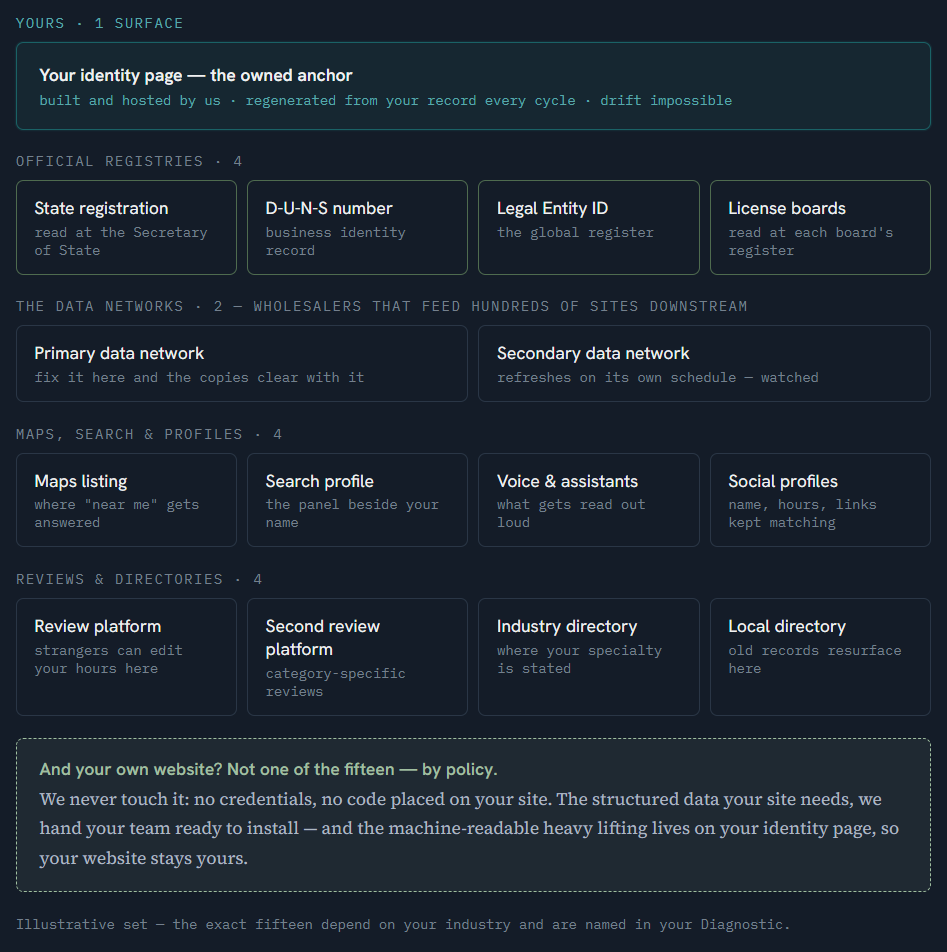
Where your identity lives — and who controls it
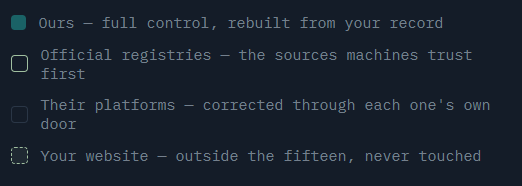
Up to fifteen places per location, each read monthly and held in agreement with your record. Fourteen belong to other people — we correct each one through its own door. One belongs to you: the identity page we build and host, generated straight from your record, where nothing can drift.
— The mechanism in one picture
Change a fact once. It reaches everywhere.
Your master record
The single master copy
Every fact confirmed by you, with its source and its date. To change anything anywhere, you change it here — once.
Generated from it
The structured data
Your identity page
Every profile update
Every correction, in each platform’s own format
Read back monthly
Every place, field by field, the way a machine reads it.
Not a sample. Divergence becomes a correction; the correction is confirmed on a later read.
— What you actually see
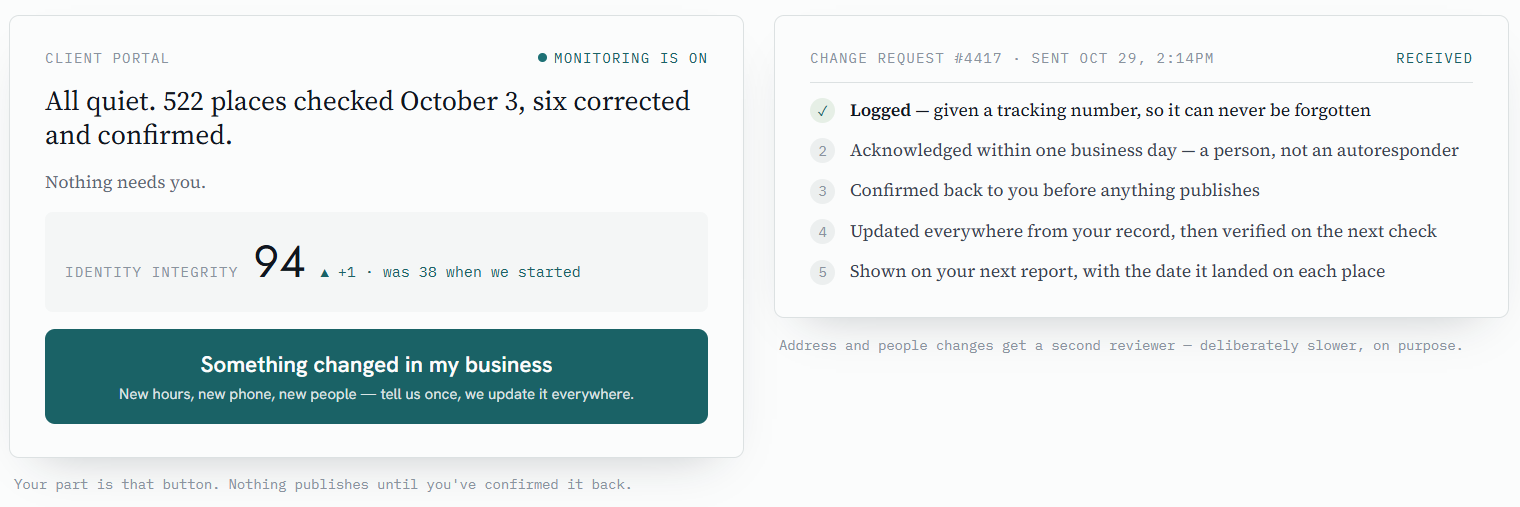
A quiet portal and a monthly scorecard. That’s the whole interface.
No dashboard to decode, nothing to configure. Your portal — reached from this site’s Client login — is a status, your report archive, and one button. Shown here with sample data for a fictional 34-hospital group.
— The proof, monthly
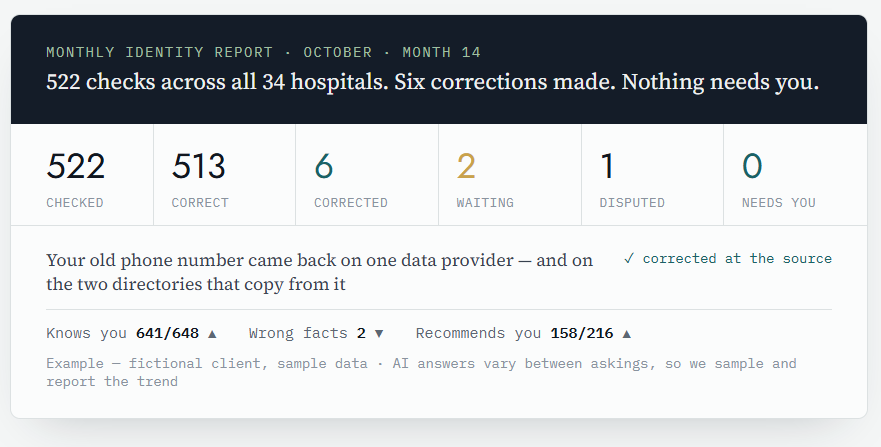
A scorecard where every line traces to a dated observation
In a good month it says everything checked was found correct — and that quiet is the product working, not idling. In a bad month it says that too, with the case references to prove it.

— Enterprise, franchise & multi-location
Scale doesn’t protect your identity. It multiplies what can fracture.
A large group carries a registered legal name, trading names, brands, old names that survived a rebrand, subsidiaries, a parent, franchisees publishing their own versions, and an acquisition history — every one a place where machines can split one business into two, or merge two into one. In our examinations, the largest organizations are frequently the most fractured.
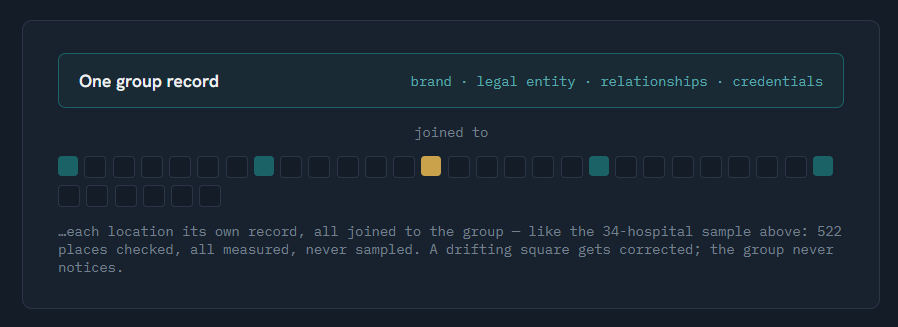
Locations are entities
850 locations isn’t 850 separate businesses — it’s one brand record plus 850 location records. Adding a location costs a row in the record and a place in the monthly pass, which is what makes even the largest portfolios tractable.
Relationships, stated explicitly
Parent, subsidiary, franchisor, franchisee — each entity gets its own identifier and the relationship is declared.
So the franchisor doesn’t absorb its franchisees’ reviews, and an acquisition doesn’t haunt today’s records.
All measured, never sampled
Every location, every month — one scorecard for the whole group, location by location, with the drift squares named. Split the reporting your way: by region or brand, or team. Old names, acquired practices, franchisee versions are watched by design.